For Russians, a Summer Vacation Abroad Is Now a Luxury Few Can Afford
Economic uncertainty and risks posed by Ukrainian drone strikes are reshaping how Russians are spending their long-awaited vacations.
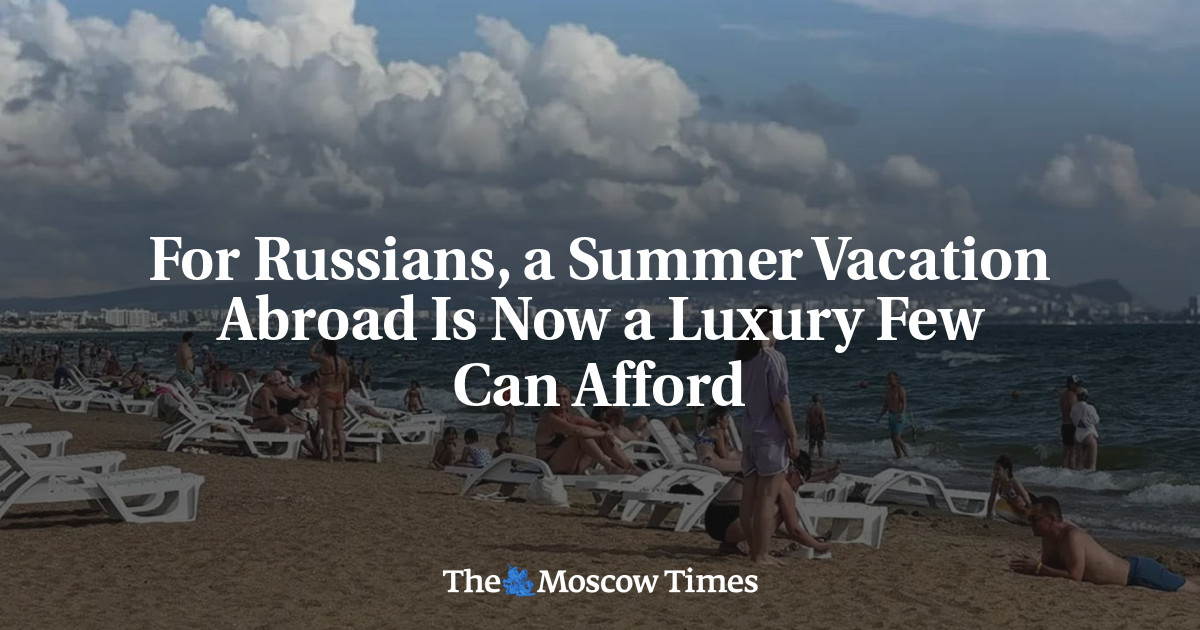
With the summer holidays in full swing, economic uncertainty and risks posed by Ukrainian drone strikes are reshaping how Russians are spending their long-awaited vacations. Residents of major cities such as Moscow and St. Petersburg — who have historically traveled abroad more often — are seeking ways to continue taking international trips despite limited flight availability and visa restrictions. But in Russia’s regions, many people appear to be opting for domestic trips — if they can afford to travel at all. “My holiday planning has changed significantly since I traveled a few years ago because I am more concerned about income issues and the current instability in the job market, which affects how much I'm willing to spend on travel,” a 33-year-old woman from Moscow said, speaking on condition of anonymity. “In the end, I’m going to Turkey on a package tour, because it is an opportunity to stay within the budget…and get some sun, sea and a relaxed mood,” she added, noting that it will be the first time she tries out a package holiday. A man walks on Red Square in Moscow. REUTERS / Ramil Sitdikov Before the full-scale invasion of Ukraine, residents of western Russia could visit major European cities on a single direct flight. Such trips now require multiple connections and are further complicated by Russia’s isolation from the international financial system, mounting visa restrictions and repeated airport closures during Ukrainian drone attacks. “Europe has not disappeared from the hearts of Russian travelers, but its place has changed,” Lyubov Chuchmayeva, deputy marketing director at tour company PAKS, told ATOR. “Today, a trip to Russians’ beloved Rome, Madrid or Paris is…a full-fledged case for the logistics department.” While more than 80% of Russians booked their holidays themselves in 2025, tour operators have reported an influx of requests from experienced travelers who can no longer rely on global low-cost airlines and accommodation platforms to arrange trips abroad, according to the Association of Tour Operators of Russia (ATOR). Giants like Airbnb and Booking.com as well as major Western airlines exited the Russian market after the invasion of Ukraine. With Europe increasingly out of reach, some Russians are embracing the Kremlin’s pivot to Asia and Africa. A woman poses for a photo on the beach in the Black Sea resort city of Yalta, annexed Crimea. REUTERS / Alexey Pavlishak China’s decision to extend visa-free entry for Russian tourists until the end of 2027 is expected to further boost interest in the country, with tour operators expecting a 50% increase in bookings compared to last year. Hong Kong, Vietnam’s Phu Quoc Island and Tanzania are also becoming more popular among Russian tourists, according to ATOR. “The restrictions of countries requiring a visa [for Russians] did not affect me, as I don’t like vacationing in Europe,” said a personal trainer from Moscow, who listed Thailand, Vietnam and Cambodia among his preferred destinations. “I don’t consider vacationing in Russia at all, as I don't see the point in spending unreasonably large amounts of money on service quality that does not match the price,” he added. Yet for many Russians who live outside the capital, domestic tourism remains the only realistic option amid the travel restrictions and rising costs. “The hardest part of planning a vacation is to have enough money for vacation when it's time to take it,” said a political activist from one of Russia’s Volga regions. The activist, who spoke on condition of anonymity, earns 40,000 rubles ($500) a month working in the public sector. This income can hardly cover even a basic tour package to Turkey, which starts at 120,000 rubles ($1,500) for two people for a 10-day stay. “When you are a political activist in Russia, you live with a constant risk of fabricated charges being brought against you or a drone flying into your home. I've developed a principle of not putting my life — and my vacations — on hold, so I try to get away from home whenever I have time off,” said the activist. “Usually I only have money for cities in the regions. I’ve been to Saratov, Sochi and Kaliningrad in the past few years. Sometimes I find cheap flights to nearby countries. That’s how I went to Yerevan [Armenia] last year,” they added. People on Palace Square in St. Petersburg. Paolo Boaretto / pexels Russia’s Black Sea coast and annexed Crimea, traditionally Russians’ preferred holiday destinations, are suffering steep losses in the tourist sector this year. Hotel bookings in Crimea in May and June decreased by 30% compared to the same period last year and travel companies reported a combined loss of 1.5 billion rubles ($18.8 million) due to cancelled trips to the annexed peninsula in June. Crimea has been suffering from acute fuel shortages since May after intensified Ukrainian strikes targeted supply routes to the peninsula and Russian oil refineries. With local airports shut down and rail service to R