‘Turbulent market’ sees major carriers favour owned tonnage over charters
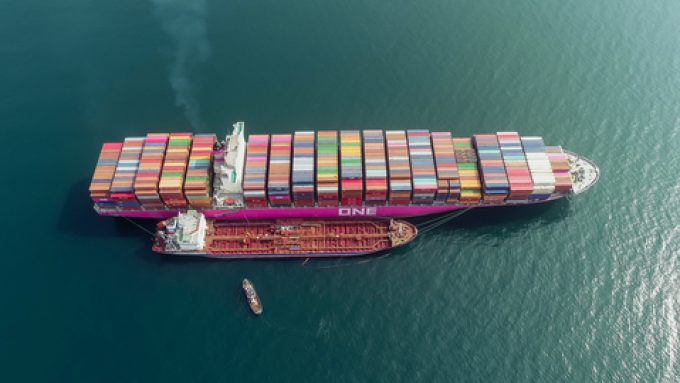
Photo: © Vladimir Serebryanskiy The world’s largest container lines have accelerated their move away from chartered tonnage, with owned vessels now accounting for almost two-thirds of their fleets. According to new analysis from Sea-Intelligence, the 12 largest global carriers have increased the percentage of owned vessels in their fleets from 43% in January 2020 to 63% – a dramatic structural shift in fleet strategy. Between January 2020 and March 2025, as the average chartered ratio fell 2.5 percentage points a year, but has since accelerated to 4.5 percentage points. Sea-Intelligence’s analysis covers MSC, Maersk, CMA CGM, Cosco, Hapag-Lloyd, ONE, Evergreen, HMM, Zim, Yang Ming, Wan Hai, and PIL. The biggest move away from chartered tonnage has been by MSC, HMM and Wan Hai, while Hapag-Lloyd has made “essentially no change at all”. Maersk, Cosco and Zim have also made only limited adjustments to their ownership mix. On a relative basis, Wan Hai and HMM have recorded the most significant changes. Sea-Intelligence noted Wan Hai had eliminated chartered vessels from its operated fleet entirely, while MSC, CMA CGM, Evergreen and PIL have roughly halved their exposure to charters. MSC, HMM, CMA CGM, Evergreen, Zim ,and Wan Hai have all expanded their share of operated capacity, with CMA CGM and Evergreen also significantly increasing the proportion of owned tonnage in their fleets. “Based on the developments seen in the data, we are leaning towards a hypothesis that, in the extremely turbulent market over the past six years, it is has been instrumental to acquire owned tonnage, rather than rely on the charter market, in order to grow market share substantially,” said the analyst. “This would appear logical, as in this period, the market has frequently been characterised by insufficient availability of capacity, and hence, owning vessels would be a significant strategic advantage,” it added. The findings come as the containership charter market continues to favour the owners, according to Braemar, which said vessel availability remained exceptionally limited across virtually all size segments. Prompt and forward positions remain scarce, it noted, leaving owners under little pressure to soften rate expectations. Braemar highlighted a series of recent fixtures illustrating the strength of demand. They include the 4,200 teu Fu Yang Shun Da , due for delivery later this year, reportedly fixed by X-Press Feeders on a two-year charter at around $51,000 a day. Further down the size range, the 1998-built, 2,456 teu Shengtang is reported to have secured a six-to-eight-month charter with Centrans at $60,000 a day, despite its age. The buoyant sentiment also extends to sale and purchase activity, although a shortage of available open tonnage continues to constrain deals. Braemar said the second-hand market remained “full of enquiry across all segments”, with demand from buyers continuing to outstrip the number of ships available. As a result, no reportable second-hand transactions were concluded this week, despite numerous vessels being under negotiation. The broker added that, unlike previous years, it was not seeing any seasonal slowdown in buying interest during the summer. Meanwhile, newbuilding activity also remains healthy. Braemar highlighted Songa’s order for two firm orders, plus four options, for geared 1,300 teu containerships at China’s Guangli Shipyard, with deliveries scheduled for 2028-29. Given the limited orderbook in the feeder segment, and the ageing profile of the existing fleet, Braemar said the investment was likely to prove well-timed. While chartering activity may ease seasonally this month, Braemar forecasts the market balance is unlikely to shift unless vessel availability improves substantially. “Unless we see a meaningful increase in available tonnage, which at this stage seems highly unlikely… the overall market balance looks set to remain firmly in owners’ favour,” it said.