Can ‘Russia’s Amazon’ Survive Ukraine’s Drone Campaign?
Russia’s online retail sector has thrived since the invasion of Ukraine. The attacks on Wildberries now threaten to disrupt that growth.
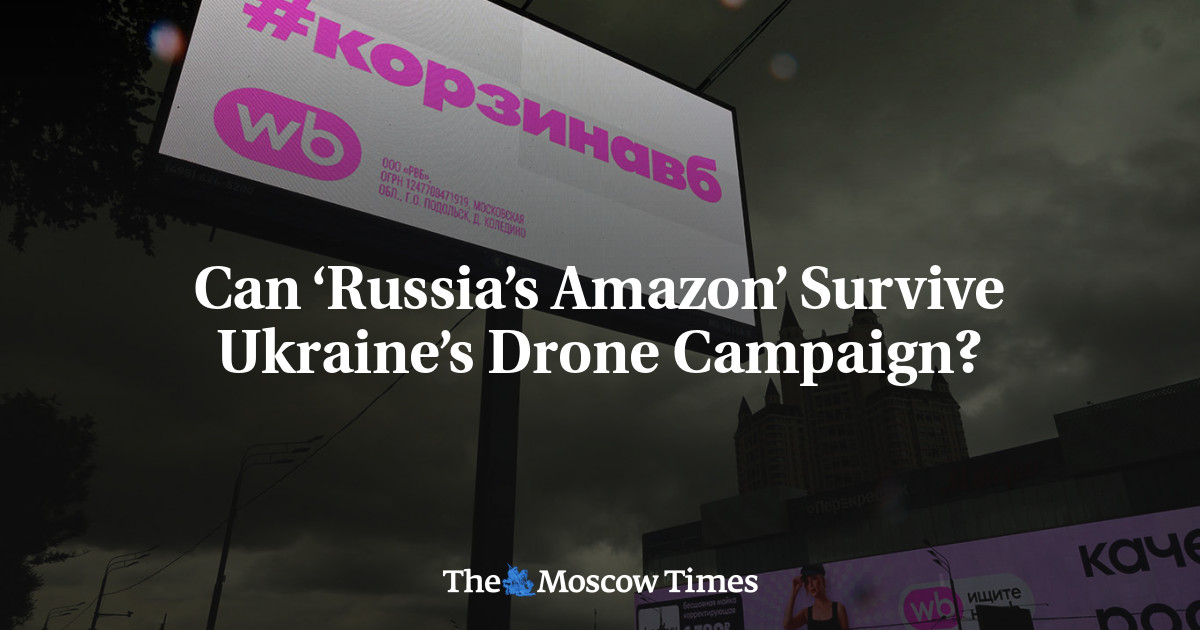
A wave of Ukrainian drone attacks has knocked out more than a quarter of Wildberries’ warehouse capacity, threatening to disrupt the logistics network behind Russia’s largest online retailer and inflict billions of dollars in losses on the company and its sellers. Analysts say the attacks are unlikely to pose a serious threat to Russia’s wider economy. But a prolonged campaign could drive up Wildberries’ costs, delay deliveries and weaken its grip on a fiercely competitive market that has expanded rapidly since Western brands left Russia following the invasion of Ukraine. The campaign, which began on July 18, has repeatedly targeted facilities where merchants’ goods are stored before being shipped to customers. Kyiv has accused Wildberries of supplying the Russian military with drone components and other equipment. By Monday, attacks had put 14 warehouses covering more than 1.5 million square meters out of operation, according to an estimate by the investigative outlet Vyorstka. That is equivalent to about 27% of the company’s total warehouse space . Wildberries is privately held, meaning there is no share price through which to gauge investor reaction. The company has also not published a comprehensive estimate of the damage caused by the strikes. Early assessments cited by Russian media nevertheless suggest that the financial impact could be substantial. The most immediate expense is the damage to Wildberries’ warehouses. Forbes Russia cited analysts who estimated that rebuilding the facilities could cost about 70,000 rubles ($861) per square meter. Applying that estimate to the 1.5 million square meters of affected warehouse space cited by Vyorstka would put the potential rebuilding bill at 105 billion rubles ($1.29 billion). That would be a significant, though likely manageable, cost for the retailer. RWB, the combined Wildberries and Russ group, reported a net profit of 175 billion rubles ($2.15 billion) in 2025. But the attacks are also creating indirect costs. The loss of conveniently located warehouses is likely to force Wildberries to reroute deliveries, use longer logistics chains and secure replacement storage. Owners of available warehouses in Russia have reportedly been reluctant to lease them to the company, prompting Wildberries to explore additional storage capacity in neighboring Kazakhstan, the Kommersant newspaper reported . Tatyana Kim, the CEO and co-founder of Wildberries. Wildberries Press Service via REUTERS The increased risks could also push up rental and insurance costs, although the overall financial impact is difficult to calculate. A potentially more serious problem is the destruction of goods belonging to merchants that use the platform. Forbes Russia estimated sellers’ potential losses at between 214.9 billion and 279.6 billion rubles ($2.64 billion-$3.44 billion). The calculation was based on compensation paid after a 2024 fire at Wildberries’ 112,000-square-meter warehouse in St. Petersburg , when sellers received almost 35 billion rubles ($431 million) for destroyed stock. Wildberries CEO Tatyana Kim said that even though the company was not legally required to compensate sellers for goods destroyed in this summer’s drone attacks, it was discussing ways to provide them with financial assistance. Even if Wildberries pays partial compensation, the losses could slow activity on the platform by leaving some sellers unable to replace their stock and continue trading. For its part, the Russian government said it was preparing measures to support affected sellers. The RBC business news outlet reported that these could include compensation based on the cost of the goods destroyed. If the government were to cover losses near the midpoint of Forbes Russia’s estimate, compensation could cost about 250 billion rubles ($3.08 billion). That would be significant but not transformative for the wider economy. Russia’s original 2026 budget envisaged a deficit of 3.79 trillion rubles ($46.6 billion), equivalent to 1.6% of gross domestic product. An additional 250 billion rubles would increase the deficit target by about 6.6%, to roughly 4.04 trillion rubles ($49.7 billion), or around 1.7% of GDP. The ultimate cost will depend largely on how long the attacks continue, how many more warehouses are damaged and how quickly Wildberries can restore or replace its lost logistics capacity. Satellite imagery shows smoke rising from a Wildberries facility in St. Petersburg. Planet Labs PBC via REUTERS Wartime growth Russia’s online retail sector has thrived since the full-scale invasion of Ukraine. After Western brands left the Russian market in 2022, local sellers rushed to fill the gap with domestic and Chinese alternatives. Online marketplaces such as Wildberries — often described as Russia’s answer to Amazon — gave them a platform to reach customers across the country. As a result, Wildberries’ gross merchandise value, which measures the total value of goods and services sold through the platform,