AI meets the air cargo pallet
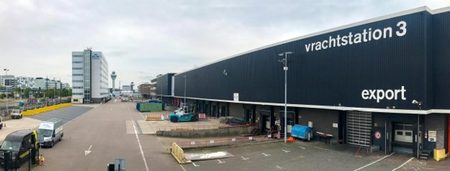
A Proof of Concept (PoC) carried out in KLM’s warehouse has demonstrated that robotics combined with vision AI, can automate parts of one of air cargo’s more complex handling tasks: building up and breaking down mixed aircraft pallets. The test, conducted by KLM, Fizyr, DERO GROEP, and Viroteq, brings automation into an area where cargo variability has so far made conventional robotic handling difficult. The photo shows KLM’s cargo terminal at Amsterdam Schiphol Airport – Cargo Station 3 Export – courtesy of KLM Cargo KLM’s test in its own warehouse On 20SEP26, Fizyr disclosed the results of a PoC carried out in KLM’s warehouse, exploring the use of robots to break down and build up air cargo pallets. PMC pallets are aircraft pallets used to consolidate different shipments for transportation by air. Unlike standardized industrial pallets carrying identical products, a single PMC pallet can contain cartons with very different dimensions, weights, shapes, and packing materials. The orientation and position of the cargo, as well as deformation or movement during transport, can make the task even more unpredictable. There is not yet a commercial solution for this particular air cargo application. The PoC demonstrated that automated mixed palletizing and depalletizing is technically feasible and, according to DERO GROEP, operationally valuable. Vision-Guided Robotics The robot receives no information in advance about the content of the air cargo pallet. It has to detect what is there in real time, interpret it, and decide what to do. When tearing down and building up the pallets, seeing the boxes is only half the battle. The required capabilities came from three technology companies, combining vision AI, palletizing intelligence, and robotics. Viroteq was brought in specifically to handle the palletizing logic, including density optimization, stability control, and collision-free trajectories. Acting as another part of the ‘brain’, Fizyr’s Vision AI analyzed the camera feeds in real time to segment and classify individual items, determine grasp points and approach angles, and provide placement guidance to the robotic system. DERO GROEP’s robotic system used Fizyr’s AI and Viroteq’s palletizing intelligence to handle the variability of cargo on aircraft pallets. Operational impact For KLM, the experiment goes beyond testing a robotic arm. Fizyr describes physical AI as part of KLM’s future warehouse strategy, aimed at making operations less physically demanding and more flexible. Building up and breaking down aircraft pallets is currently a manual, repetitive, and physically demanding process. Automating part of this work could reduce the amount of heavy lifting performed by warehouse employees while giving cargo operations greater flexibility in handling changing volumes. However, technical feasibility alone does not make the system ready for daily cargo operations. KLM has not yet announced a production deployment. From PoC to warehouse reality The next question is whether this technology can deliver the reliability, throughput, and economics required in a working air cargo terminal. A successful PoC shows that robots can handle the variability of mixed cargo. Turning that capability into a system that can perform consistently under real operational conditions is the next challenge. For KLM, that will determine whether vision-guided robotics moves from a warehouse experiment into daily cargo operations.